
€ 175


Still questions? Contact us
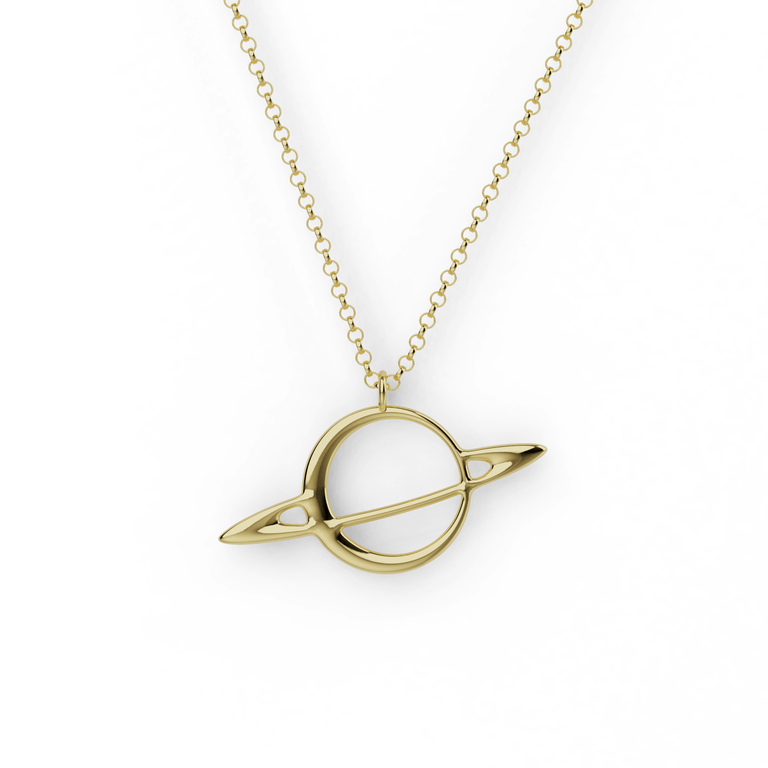
Saturn necklace | 18k gold vermeil
In the summer of 1610, Galileo turned his telescope on Saturn and saw something he could not interpret. He described the planet as "triple-bodied," with two strange protrusions on either side. It took Christiaan Huygens, with a better telescope and forty-five years of further work, to identify those protrusions as a flat ring system surrounding the planet.
The Science of Saturn
Saturn's rings are not solid. They are a dynamic system of orbiting particles, mostly water ice, ranging from dust grains to chunks the size of houses. The ring system extends from about 7,000 km above Saturn's cloud tops out to roughly 80,000 km, but is on average only ten metres thick. Gravitational resonances with Saturn's moons sculpt the ring structure: the Cassini Division (the largest gap, visible from Earth in modest telescopes) is maintained by a 2:1 orbital resonance with the moon Mimas. Saturn's polar hexagon, a persistent hexagonal cloud pattern around the planet's north pole with a side length of about 13,800 km, is one of the most geometrically regular large-scale atmospheric structures in the solar system.
A Quiet Symbol For
The audience falls into a few clear groups:
- planetary scientists and astronomers working on the outer solar system
- amateur astronomers who own a telescope and know exactly where Saturn is tonight
- physicists and engineers who worked on Cassini, Huygens, or related missions
- science teachers and planetarium staff who use Saturn as the gateway to planetary science
- anyone who has seen Saturn through a telescope and remembers exactly what that felt like
About a third of orders ship to working astronomers and planetary scientists. The rest go to amateur observers and to people who saw Saturn once at a public observatory and never forgot it.
Explore Related Astronomy Jewelry
- Saturn necklace | silver
- Saturn ring | silver
- Orion necklace L | gold vermeil
- CubeSat necklace | silver
FAQ
What does an astronomer see when they look at this?
The same planet they have spent time with through a telescope. Saturn is the planet most amateur astronomers point new observers at first because the ring system is unmistakable even at modest magnification. A piece that names this specific planet rather than gesturing at "space" tends to read as well-chosen by anyone whose interest in astronomy is real rather than ornamental.
Why are Saturn's rings so much more visible than the rings of the other gas giants?
Because they are far brighter and much wider. Jupiter, Uranus, and Neptune all have ring systems too, but they are dark, narrow, and made mostly of dust rather than ice. Saturn's rings are made primarily of water ice, which reflects sunlight efficiently, and they extend across a much wider radial range than the other systems. The Cassini probe also showed that the rings are dynamic and probably geologically young, possibly less than 100 million years old, which means we may be looking at Saturn during a brief and unusual chapter of its history.
What's the size, material, and chain?
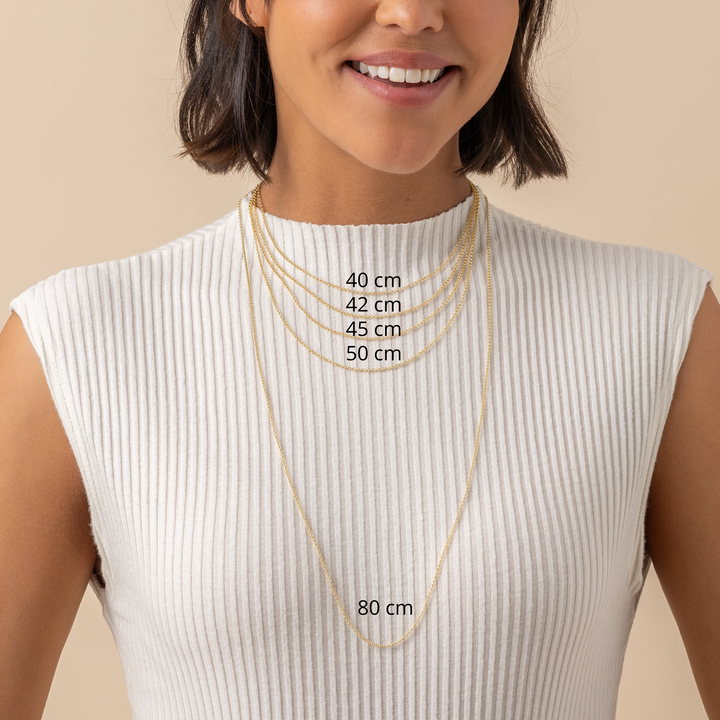
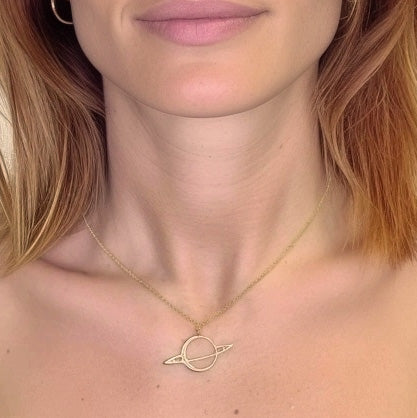
37 mm pendant in 18k gold vermeil over a sterling silver core, nickel-free. 45 cm gold vermeil chain with a 5 cm extender. Ships free worldwide via DHL Express in 1-5 business days, with all import duties prepaid. Comes in a ready-to-gift jewelry box with the 30-day “Love It or Return It” policy.
Same design as the silver Saturn?
Yes. Same model, same 37 mm size. Material is the only difference. The silver is the everyday piece. The gold reads warmer and reads more formal, often picked as a milestone gift or a self-purchase by someone who has wanted Saturn in gold for a while.

Math & Physics
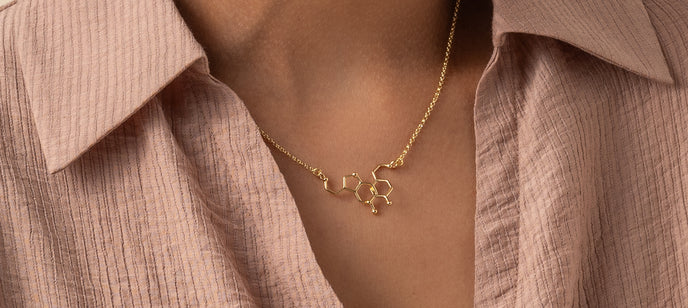
Unlock the elegance of the abstract with our math and physics-inspired jewelry collection. These carefully crafted pieces mirror the profound equations and natural laws that shape our understanding of the universe. Experience the allure of fractals, the rhythmic beauty of pi, and the celestial wonder of astral formations—each piece serves as a wearable homage to the artistry inherent in scientific inquiry.
Find your perfect fit: measure an Existing Ring
Finding out your ring size at home is a simple process and can help you shop for jewelry online with confidence.
Necklace length guide