€ 160


Still questions? Contact us
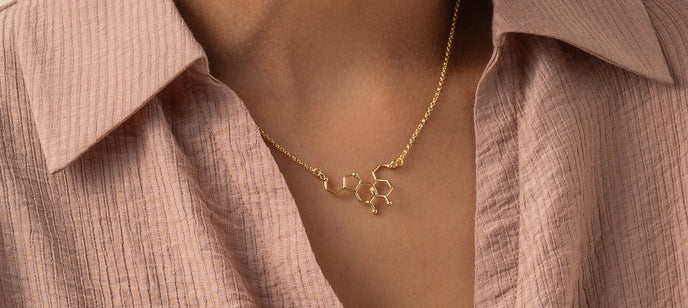
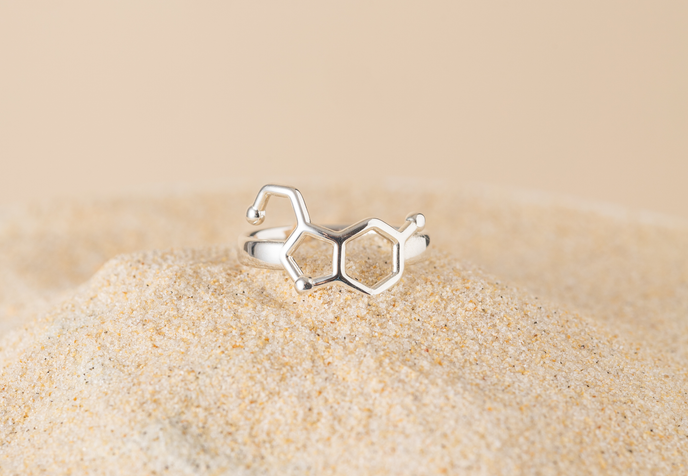
THC necklace | sterling silver
THC has 21 carbon, 30 hydrogen and 2 oxygen atoms, the same as CBD, yet the two act quite differently in the body. An organic chemist wearing her sterling silver THC molecule necklace has a name for the pair: structural isomers, the same atoms joined in a different way.
Who It's For
- a good friend
- a wife whose initials became THC after she married
- a pharmacologist or a neuroscientist
- a plant scientist
- a pharmacy or pharmacology student
How the Cannabis Plant Makes THC
The cannabis plant does not make THC directly. Tiny glands on the plant make THCA, an acid form. An enzyme called THCA synthase builds it by closing part of a precursor, cannabigerolic acid, into a ring. THCA becomes THC when it loses carbon dioxide, with no enzyme involved, on exposure to heat or light. A team at Kyushu University reported evidence in 2005 that the enzyme works in the gland's storage cavity, a pocket its cells secrete into, rather than inside the cells. In 2007 the same group reported that THCA can kill cannabis leaf cells.
Explore Related Molecule Jewelry
- THC necklace | gold vermeil
- THC necklace 3D | silver
- psilocybin necklace | silver
- dopamine necklace H | silver
FAQ
How big is the pendant, and how does it sit?
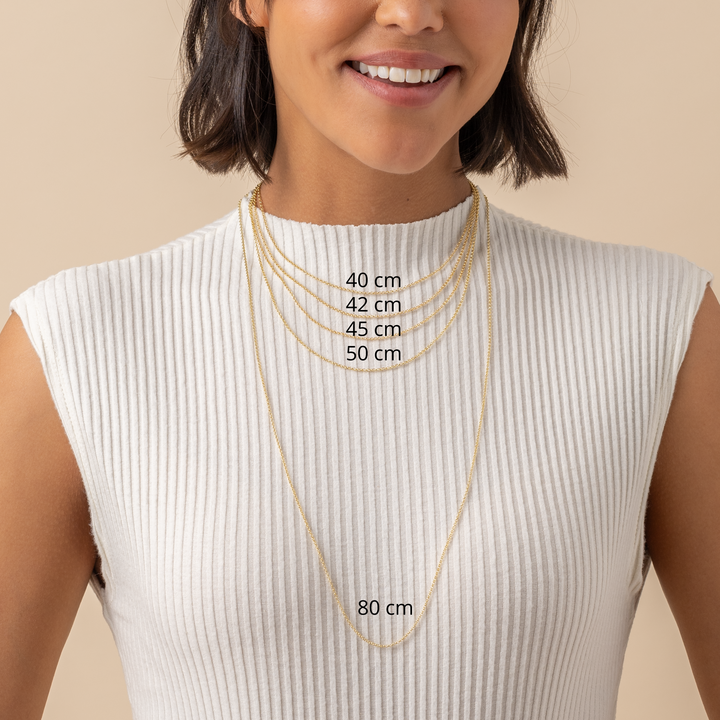
The pendant measures 45 mm (about 1.8 inches), about 21 mm more than a US quarter (24.26 mm). The chain is attached at both ends of the pendant, so it hangs in line with the chain and sits a little lower than the 45 cm (17.7 inch) chain length alone suggests. The chain has a 5 cm (2 inch) extender. Our 925 sterling silver is nickel-free and hypoallergenic.
Is there a gold version, or a 3D one?
Yes, both. This THC necklace also comes in gold vermeil, with the same flat 45 mm pendant on a 45 cm gold vermeil chain with a 5 cm extender. Choose the finish the recipient already wears. The design is the same in both finishes. The THC necklace 3D is a different design, a three-dimensional ball-and-stick pendant, also 45 mm, and comes in sterling silver only.
Will it arrive in time, and what if it isn't right?
DHL Express delivers it free worldwide in 1-5 business days, and we pay the import duties and taxes, so nothing is due at the door. It arrives in a ready-to-gift jewelry box and festive envelope. If it isn't right, our 30-day “Love It or Return It” policy applies.
How did Allyn Howlett and colleagues show that the brain has a receptor for THC?
By tracing what THC did inside nerve-derived cells, then measuring how a labelled cannabinoid bound to brain tissue. In 1984 Howlett reported that THC lowered cyclic AMP, a messenger inside cells, in neuroblastoma cells. In 1988, W. A. Devane, Howlett and colleagues at Saint Louis University reported that they had labelled a synthetic cannabinoid, CP-55,940, with radioactive tritium and found a single class of binding sites in rat brain membranes. The criteria for a cannabinoid receptor in rat brain tissue, they wrote, had been fulfilled.
Molecules
Delve into the hidden elegance of science with our meticulously crafted jewelry, inspired by the intricate structures of chemical molecules. Each piece serves as a tactile tribute to the building blocks of life and matter, capturing the allure of atoms and bonds in precious metals. A harmonious fusion of art and science, these creations are more than mere accessories; they're a celebration of the enigmatic beauty that underpins our universe.
Find your perfect fit: measure an Existing Ring
Finding out your ring size at home is a simple process and can help you shop for jewelry online with confidence.
Necklace length guide