€ 150


Still questions? Contact us
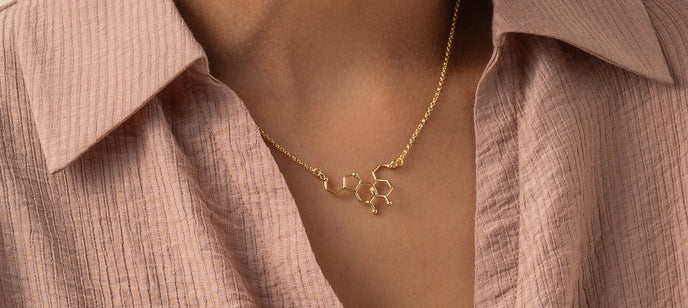
Phospholipid necklace | sterling silver
In one reviewer's words, this phospholipid necklace is “discreetly nerdy”, and the molecule is discreet too: the membrane around every cell in your body is built on phospholipids, in a layer only about five nanometres thick. Wrap it for a scientist who likes her science understated.
Who It's For
- a friend who works with liposomes
- a daughter who is a science geek
- yourself, to wear on exam day
Michelle B., on a gift: “Nice workmanship. Pretty charm.”
How Phospholipids Move in a Membrane
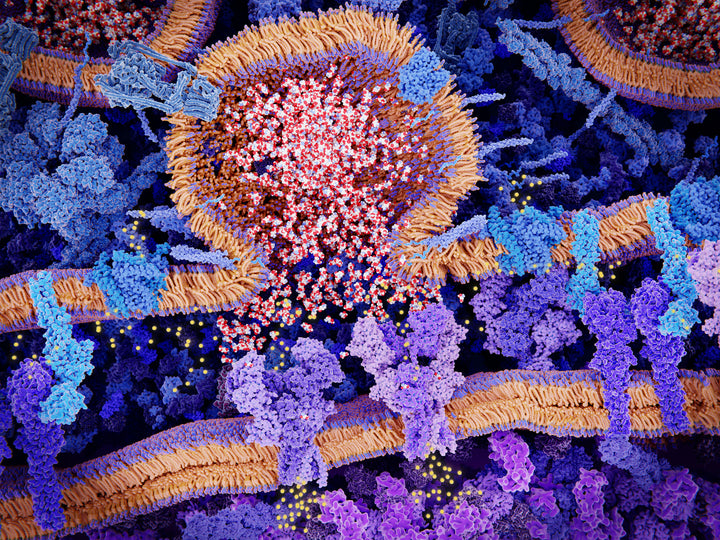
A cell membrane never keeps still. In a fluid membrane, each phospholipid trades places with its neighbours millions of times a second, drifting freely within its own layer. Crossing to the other layer is another matter: the water-loving head would have to pass through the oily core, so on its own a phospholipid makes that flip only rarely. Cells put that slowness to use. Enzymes called flippases keep some phospholipids, phosphatidylserine among them, on the inner face. When a cell dies by apoptosis, phosphatidylserine appears on the outside, and macrophages take it as one of the signals to clear the cell away.
Explore Related Cell Biology Jewelry
- phospholipid necklace | gold vermeil
- membrane necklace | silver
- 7TMR necklace | silver
- mammalian cell necklace | silver
FAQ
How big is it, and how does it sit?
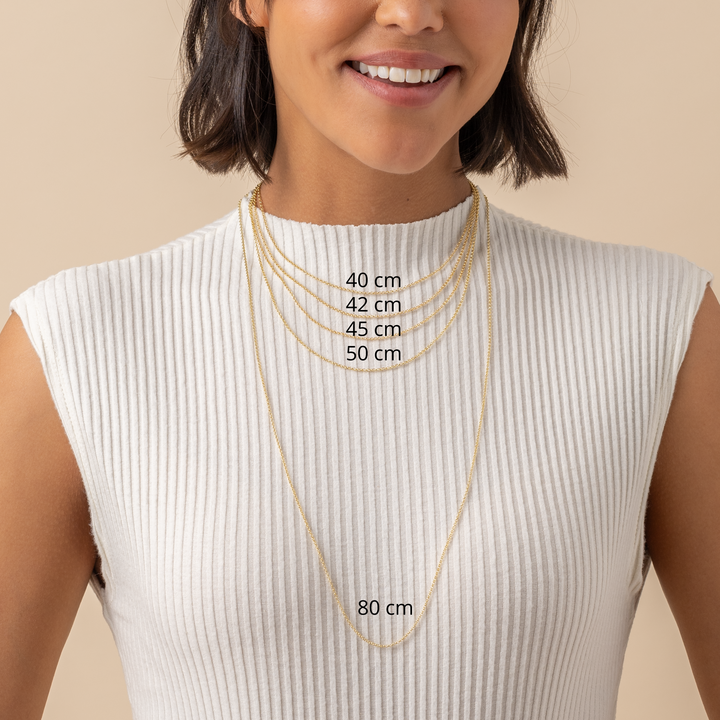
The pendant measures 18 mm (about 0.7 inch), almost exactly the diameter of a US dime (17.91 mm). It is fixed to a 45 cm (17.7 inch) sterling silver chain with a lobster clasp and a 5 cm (2 inch) extender, so it can be worn anywhere from 45 to 50 cm (17.7 to 19.7 inches). On the model photo it hangs upright at about collarbone height. Our sterling silver is nickel-free and hypoallergenic.
Is there a gold vermeil version, or something larger?
Yes. The phospholipid necklace also comes in 18K gold vermeil, at the same 18 mm, on a 45 cm gold vermeil chain with a 5 cm extender. Choose the finish the recipient already wears. The design is the same in both finishes. For something larger on a related theme, the membrane necklace has a 42 mm pendant and comes in sterling silver and in 18K gold vermeil.
Will it arrive in time, and what if it isn't right?
DHL Express delivers it free worldwide in 1-5 business days, and we pay the import duties and taxes, so nothing is due at the door. It arrives in a ready-to-gift jewelry box and festive envelope. If it isn't right, our 30-day “Love It or Return It” policy applies.
Who discovered liposomes?
Alec Bangham, a biophysicist at the Institute of Animal Physiology in Babraham, near Cambridge. By 1962 the institute had an electron microscope, operated by Bob Horne, a sailing friend of his, which is how Bangham got the first bookings. Horne insisted on looking at his phospholipid suspensions in negative stain, and at their very first session they saw closed vesicles all over the place. Proving it took two more years. A visitor, Gerald Weissmann, took the system back to the US and renamed the little bags liposomes.
Cellular Biology
Step into the fascinating world of cellular biology through our unique jewelry designs. These pieces serve as wearable reflections of life's microscopic wonders, capturing the aesthetics of DNA strands, cellular formations, and more. Far from simple adornments, they spark dialogue and honor the captivating complexities found within biological research. Merging scientific accuracy with artistic flair, each creation offers a tactile experience that bridges the gap between scientific inquiry and aesthetic appreciation.
Find your perfect fit: measure an Existing Ring
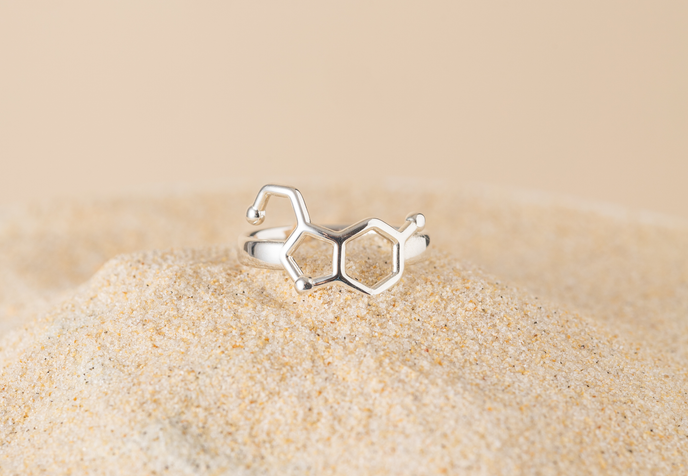
Finding out your ring size at home is a simple process and can help you shop for jewelry online with confidence.
Necklace length guide